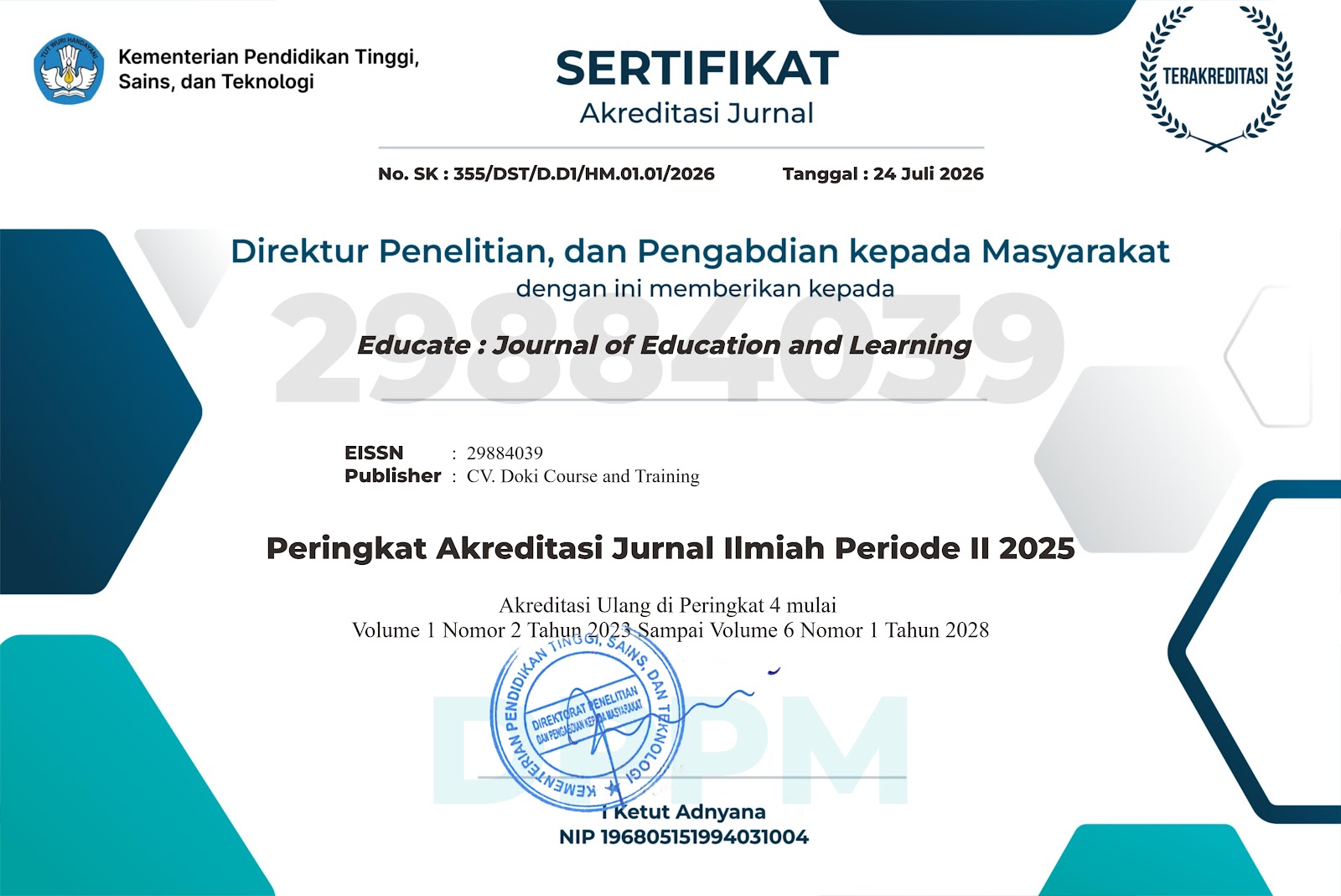
Learning English through Short Videos: Exploring Students’ Experiences in an EFL Classroom
DOI:
https://doi.org/10.61994/educate.v4i1.1569Keywords:
Short Video-Based Learning, English as a Foreign Language (EFL), Students’ Learning Experiences, Multimedia-Assisted Instruction, Qualitative Descriptive ResearchAbstract
The growing use of short video platforms such as TikTok, YouTube Shorts, and Instagram Reels has increasingly influenced how students are exposed to English. In Indonesian English as a Foreign Language (EFL) classrooms, short videos are often used as supplementary learning media; however, empirical studies that focus on students’ actual learning experiences remain limited. This study aims to explore students’ experiences of learning English through short videos in an Indonesian EFL classroom. A qualitative descriptive research design was employed. The participants were ten eighth-grade students from a private junior high school in Pematangsiantar, Indonesia, selected through purposive sampling. Data were collected through classroom observations and semi-structured interviews and analyzed using thematic analysis. The findings reveal that short videos create a more engaging and less intimidating learning environment, facilitate vocabulary comprehension through visual and contextual support, and increase students’ confidence in classroom interaction. However, students also encountered challenges, particularly related to fast speech and limited processing time. This study contributes to EFL research by providing empirical insights into students’ lived experiences of short video–based learning in the Indonesian EFL context. The findings offer practical implications for EFL teachers, highlighting the importance of careful video selection and pedagogical scaffolding to optimize the use of short videos in classroom instruction
References
Harmer, J. (2015). The practice of English language teaching (5th ed.). Pearson Education. https://www.pearson.com/us/higher-education/program/Harmer-Practice-of-English-Language-Teaching-The-5th-Edition/PGM332433.html
Jiang, Y., & Luk, J. (2022). Digital multimodal texts and learner engagement in EFL classrooms. Language and Education, 36(4), 315–330. https://doi.org/10.1080/09500782.2021.1938193
Krashen, S. D. (1982). Principles and practice in second language acquisition. Pergamon Press. http://www.sdkrashen.com/content/books/principles_and_practice.pdf
Mayer, R. E. (2009). Multimedia learning (2nd ed.). Cambridge University Press. https://doi.org/10.1017/CBO9780511811678
Mayer, R. E. (2014). The Cambridge handbook of multimedia learning (2nd ed.). Cambridge University Press. https://doi.org/10.1017/CBO9781139547369
Paivio, A. (2007). Mind and its evolution: A dual coding theoretical approach. Psychology Press. https://doi.org/10.4324/9781315802026
Richards, J. C., & Renandya, W. A. (Eds.). (2002). Methodology in language teaching: An anthology of current practice. Cambridge University Press. https://doi.org/10.1017/CBO9780511667190
Sadiman, S. (2018). Media pendidikan: Pengertian, pengembangan, dan pemanfaatannya. Raja Grafindo Persada. https://rajagrafindo.co.id/produk/media-pendidikan/
Sari, P., & Pratama, B. (2021). Students’ attitudes toward using short videos for English learning. Journal of English Education Studies, 4(1), 23–34. https://doi.org/10.30653/005.202141.38
Sherman, J. (2003). Using authentic video in the language classroom. Cambridge University Press. https://doi.org/10.1017/CBO9780511734984
Wang, L. (2020). Exploring EFL learners’ perceptions of short video-based learning in mobile environments. CALL-EJ, 21(2), 12–27.
http://callej.org/journal/21-2/Wang2020.pdf
Yoon, S. Y., & Kim, H. (2020). The role of visual media in enhancing EFL learners’ engagement. ELT Journal, 74(4), 415–424. https://doi.org/10.1093/elt/ccaa030
Downloads
Published
Issue
Section
Categories
License
Copyright (c) 2026 Diana Dian Sari Tampubolon, Selviana Napitupulu

This work is licensed under a Creative Commons Attribution-ShareAlike 4.0 International License.