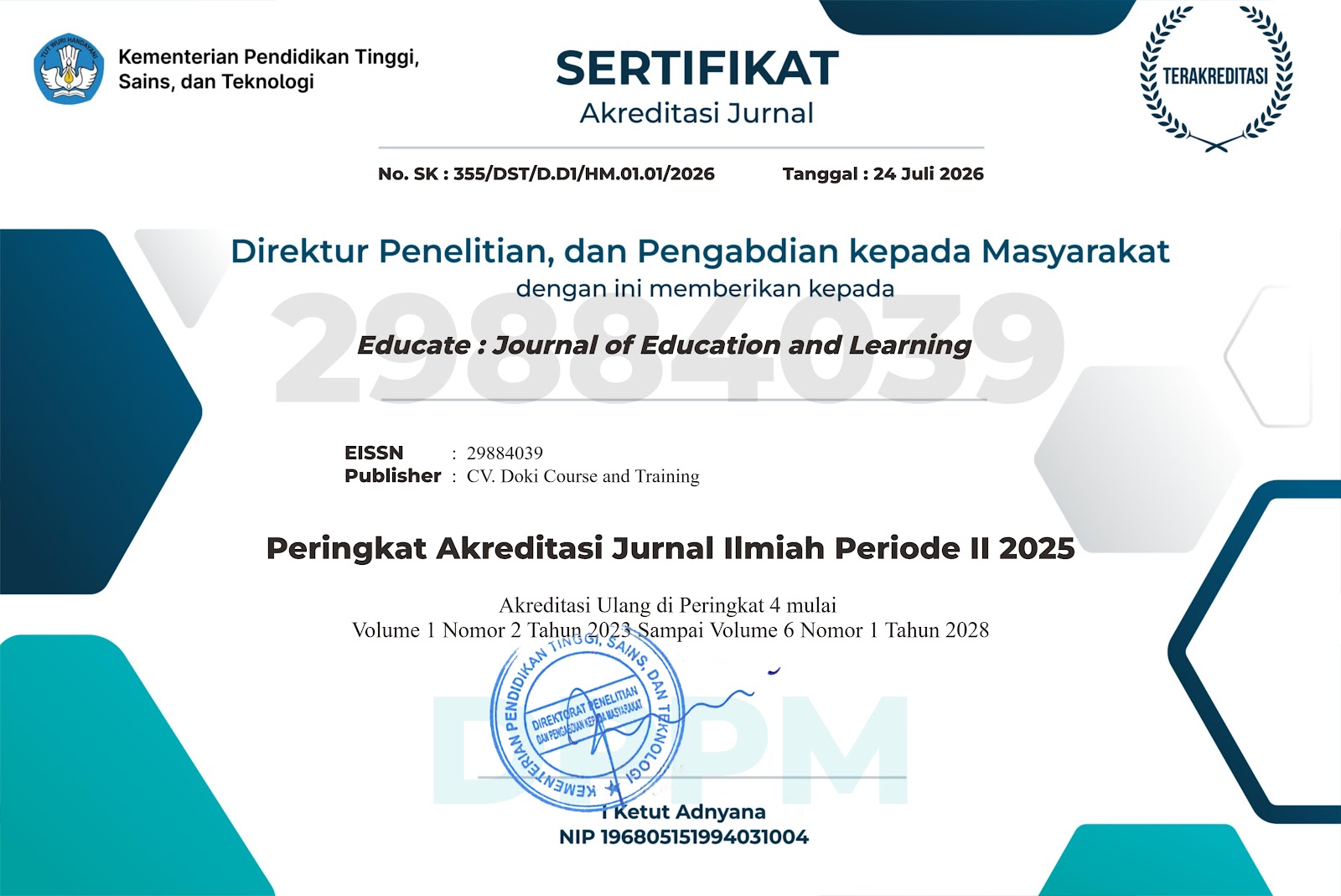
Evaluation Of Character Education Programs In Islamic Boarding Schools: Using The Cipp Evaluation Model To Measure Long-Term Impact
DOI:
https://doi.org/10.61994/educate.v3i2.2259Keywords:
character education, CIPP evaluation model, pesantrenAbstract
This integrative literature review examines the evaluation of character education programmes in Indonesian pesantren through the CIPP (Context, Input, Process, Product) model, with particular attention to long-term impact on alumni character development. A structured search on Google Scholar yielded 42 peer-reviewed sources published between 2020 and 2025, which were synthesised thematically across the four CIPP domains. Findings indicate that while institutional vision aligns strongly with national character education policy, critical gaps persist in pedagogical training, budgetary allocation, and implementation fidelity of less structured activities. Product evaluation reveals that dispositional traits such as integrity and social responsibility demonstrate greater long-term durability than ritual-bound behaviours, with alumni community engagement serving as a significant moderating factor. The review advocates for a culturally contextualised adaptation of the CIPP model that incorporates pesantren-specific elements, including the spiritual authority of the kyai and the hidden curriculum. Practical recommendations include institutionalised alumni tracking, increased character-specific funding, and periodic CIPP-based programme assessments.
References
Abdullah, M. R., Muhamad, F. N., Abdullah, Z. H., Amonov, B., Yaakob, M. A., Author, A., Islam, U., Tuanku, A., Sirajuddin, S., Fatimah, M. ;, Muhamad, N., Zaimah, M. ;, & Abdullah, H. (2025). Exploring the mediating effect of academic self-efficacy on metacognitive awareness and students’ academic writing skill in Islamic higher education. Journal of Instruction and Islamic Religious Education, 1(2), 135–152. https://doi.org/10.63826/JIIRE.V1I2.175
Achmadin, B. Z., Kawakip, A. N., Nafis, M. M., Barizi, A., Asrori, M., & Amrullah, A. M. K. (2024). The Future of Pesantren: Reconciling Tradition with Global Educational Trends. Jurnal Pendidikan Agama Islam (Journal of Islamic Education Studies), 12(2), 197–222. https://doi.org/10.15642/JPAI.2024.12.2.197-222
Akhlakul, K., Di, K., Disrupsi, E., Luthfi, D., Supyan, A. A., & Harmonika, S. (2025). Character Education Based on Islamic Boarding School Values: Building Good Character in the Age of Digital Disruption. Jurnal Pendidikan Guru Madrasah Ibtidaiyah Al-Amin, 4(1), 368–386. https://doi.org/10.58230/27454312.3205
Alanshori, M. Z., Maulidi, A., Zahidi, S., Kusaeri, K., & Suparto, S. (2025). The Application of the CIPP Evaluation Model in Educational Programs in Indonesia. Scaffolding: Jurnal Pendidikan Islam Dan Multikulturalisme, 7(2), 103–122. https://doi.org/10.37680/SCAFFOLDING.V7I2.7390
Amini, I., & Maharot, |. (2017). Nilai Islam dalam Kepemimpinan Efektif dan Aplikasinya Pada Lembaga Pendidikan Islam. Maharot : Journal of Islamic Education, 1(1), 71–87. https://doi.org/10.28944/MAHAROT.V1I1.183
Anintyawati, R. (2021). The Character of The Students in MTs. Al-Mahalli Bantul Yogyakarta (A Comparative Study on Students Staying in Pesantren and Outside Pesantren). Southeast Asian Journal of Islamic Education Management, 2(1), 29–38. https://doi.org/10.21154/SAJIEM.V2I1.39
Aryati, G. A. P. B., Divayana, D. G. H., & Ratnaya, I. G. (2023). Evaluation of Character Education in Public High School Using the CIPP Model. Jurnal Pendidikan Dan Pengajaran, 56(2), 349–358. https://doi.org/10.23887/JPP.V56I2.66144
Atianashie, M., Atianashie, M., Kuffour, M. K., Kyiewu, B., & Serwaa, P. (2025). Responsible AI for AI Sustainable Future: Governance, Ethics, and The Reality Behind the Promise. Journal of Information Technology, Cybersecurity, and Artificial Intelligence, 2(2), 1–19. https://doi.org/10.70715/jitcai.2025.v2.i2.012
Ayu, D., Asri, P., Mustaghfiroh, R., Cahyani, R. N., Mustofa, R., & Amalia, K. (2025). Quality Assurance in Faith-Based Education: A Case Study of MA Muhammadiyah 1 Kota Yogyakarta. Journal of Islamic Education Management Research, 3(1), 73–90. https://doi.org/10.14421/JIEMR.2025.31-06
Azka, M. E., Syahriani, F., Azyzy, M., Hafidz, A., Mulyani, F. F., Syahnur, L., & History, A. (2025). Revitalization of Character Education to Overcome Moral Crisis Among Islamic Boarding School Students in Digital Era. Journal of Educational Management and Strategy, 4(1), 15–28. https://doi.org/10.57255/JEMAST.V4I1.1414
Bahiyah, U. (2025). Strategies and Models of Character Education Based on Religious Values in the Era of Globalized Education. QALAMUNA: Jurnal Pendidikan, Sosial, Dan Agama, 17(1), 729–740. https://doi.org/10.37680/QALAMUNA.V17I1.7122
Basori, R., Raharjo, T. J., Prihatin, T., & Yulianto, A. (2023). Maintaining Salafi Values through Innovative Management Practices at Pesantren. Jurnal Pendidikan Islam, 9(2), 145–156. https://doi.org/10.15575/JPI.V9I2.25376
Herak, R. (2025). Character Education in the Digital Age: Challenges and Opportunities Amidst Technological Developments. MSJ : Majority Science Journal, 3(2), 245–252. https://doi.org/10.61942/msj.v3i2.367
Curtis, H. L., Gabriel, L. C., Sahakian, M., & Cattacin, S. (2021). Practice-Based Program Evaluation in Higher Education for Sustainability: A Student Participatory Approach. Sustainability 2021, Vol. 13, Page 10816, 13(19), 10816. https://doi.org/10.3390/SU131910816
Dzakpasu, I. M. (2024). An evaluation of teaching and learning of English Language in Technical Vocational Institutes in the Greater Accra region using the Context, Input, P-Process, and Product (CIPP) Model. http://41.74.91.244:8080/handle/123456789/4992
Stufflebeam, D. L., & Coryn, C. L. S. (2014). Evaluation Theory, Models, and Applications, 2nd Edition. Jossey-Bass.
Fauzi, I.-, Syafe’i, I., & Amiruddin, A. (2022). Character Education: Its Implementation at Islamic Boarding School. Journal of Advanced Islamic Educational Management, 2(1), 35–42. https://doi.org/10.24042/JAIEM.V2I1.15797
Gusenbauer, M., & Haddaway, N. R. (2020). Which academic search systems are suitable for systematic reviews or meta-analyses? Evaluating retrieval qualities of Google Scholar, PubMed, and 26 other resources. Research Synthesis Methods, 11(2), 181–217. https://doi.org/10.1002/JRSM.1378;ISSUE:ISSUE:DOI
Hidayati, N. N., & Nihayah, D. H. (2025). A Comparative Study of Character Education Practices Across Nations: Lessons and Insights for Global Implementation. Dewantara: Journal of Education Research, 1(1), 26–54. https://ejournal.yph-annihayah.com/index.php/djer/article/view/2
Hidayatullah, A. S., Fitroni, M. H., & Khaudli, M. I. (2025). Examining The Characteristics And Differences Between Salafiyah, Khalafiyah, And Comprehensive Islamic Boarding School From The Perspective Of Islamic Education Management. EMJ : Educational Management Journal, 6(1), 163–171. https://ejournal.uimsya.ac.id/index.php/emj/article/view/4541
Iskandar, H., Hasbi, Y., Idami, Z., & Saputra, F. (2025). Islamic Law and the Constitution: Analyzing the Compatibility of Religion-Based Legislation in Indonesia. Al-Qadha : Jurnal Hukum Islam Dan Perundang-Undangan, 12(2), 332–355. https://doi.org/10.32505/QADHA.V12I2.11652
Ke, P., Ciais, P., Sitch, S., Li, W., Bastos, A., Liu, Z., Xu, Y., Gui, X., Bian, J., Goll, D. S., Xi, Y., Li, W., O’Sullivan, M., De Souza, J. G., Friedlingstein, P., & Chevallier, F. (2024). Low latency carbon budget analysis reveals a large decline of the land carbon sink in 2023. National Science Review, 11(12), 813–831. https://doi.org/10.1093/nsr/nwae367
Lutfi, M., Asnawi, N., Mulyono, Tufail, I., & Erlangga, I. S. (2025a). Character and Life Skill Based Management of Pesantren Education in Shaping the Quality of Graduates. EDUKASI: Jurnal Penelitian Pendidikan Agama Dan Keagamaan, 23(3), 610–626. https://doi.org/10.32729/EDUKASI.V23I3.2402
Lutfi, M., Asnawi, N., Mulyono, Tufail, I., & Erlangga, I. S. (2025b). Character and Life Skill Based Management of Pesantren Education in Shaping the Quality of Graduates. EDUKASI: Jurnal Penelitian Pendidikan Agama Dan Keagamaan, 23(3), 610–626. https://doi.org/10.32729/EDUKASI.V23I3.2402
Mamanazarov, S. S., Khajiyeva, M. S., Abdullaeva, D. S., Yuldasheva, G., Azkhodjaeva, R. A., Pirnazarov, A. A., & Khamedova, N. A. (2025). Innovating Human Capital Development: The Role of Education, Law, and Economics Through Digital Transformation. Qubahan Academic Journal, 5(3), 78–113. https://doi.org/10.48161/QAJ.V5N3A1698
Mardiana, M., Ananda, R., & Rifa’i, M. (2025). Curriculum Management in Madrasah Aliyah Islamic Boarding Schools to Enhance Character Education. Journal of General Education and Humanities, 4(3), 1133–1146. https://doi.org/10.58421/GEHU.V4I3.639
Mukumbang, F. C., Marchal, B., Van Belle, S., & van Wyk, B. (2020). Using the realist interview approach to maintain theoretical awareness in realist studies. Qualitative Research, 20(4), 485–515. https://doi.org/10.1177/1468794119881985;SUBPAGE:STRING:FULL
Muthi, I. (2025). Strengthening Moral Education: A CIPP-Based Evaluation of the Adab Development Program in an Islamic Senior High School. QALAMUNA: Jurnal Pendidikan, Sosial, Dan Agama, 17(2), 1129–1138. https://doi.org/10.37680/QALAMUNA.V17I2.7539
Nashihin, M. I., Majeed, M. K., Derysmono, D., Armadi, A., & Syukur, A. (2025). The Role of Pesantren Culture in Developing Academic Character : A Study on the Positive Impact of the Cultural Environment at Pesantren Luhur Sabilussalam. Mimbar Agama Budaya, 42(1), 89–105. https://doi.org/10.15408/MIMBAR.V42I1.45255
Nurhasan, N., Makmun, S., Amaliya, N. F., Mahmud, M., & Erihadiana, M. (2025). The Dynamics and Implementation Challenges of Islamic Education Policies in Indonesian Schools and Pesantren: A Socio-Cultural Perspective. TARBAWY: Indonesian Journal of Islamic Education, 12(2), 231–246. https://doi.org/10.17509/T.V12I2.92584
Raikhan. (2024). Muhasabah Approach In Assessing Students’ Social Behaviour In Madrasahs As A Solution In Overcoming Moral Degradation. Fikroh: Jurnal Pemikiran Dan Pendidikan Islam, 17(2), 82–94. https://doi.org/10.37812/FIKROH.V17I2.1567
Rodiyah, S. (2025). Evaluating Differentiated Instruction Implementation in Early Childhood Education Using the CIPP Model. BRIDGE : The Multidisciplinary Research Portal, 3(2), 294–307. https://jurnal.sttnlampung.ac.id/index.php/bridge/article/view/184
Sadiq, H. (2022). APPLICATION OF HIGH-DURABILITY ENGINEERING MATERIALS FOR ENHANCING LONG-TERM PERFORMANCE OF RAIL AND TRANSPORTATION INFRASTRUCTURE. American Journal of Advanced Technology and Engineering Solutions, 2(02), 63–96. https://doi.org/10.63125/4K492A62
Snyder, H. (2019). Literature review as a research methodology: An overview and guidelines. Journal of Business Research, 104, 333–339. https://doi.org/10.1016/J.JBUSRES.2019.07.039
Sofi, M. J., Manaf, S., Ali, J., Abdurrahman, U. K. H., Pekalongan, W., Kusuma, J., No, B., & Baru, P. (2025). Pesantren in Dynamic Transformation: Harmonizing Classical Roots and Modern Practices. MIQOT: Jurnal Ilmu-Ilmu Keislaman, 49(2), 333–353. https://doi.org/10.30821/MIQOT.V49I2.1459
Stufflebeam, D. L. (1983). The CIPP Model for Program Evaluation. Evaluation Models, 117–141. https://doi.org/10.1007/978-94-009-6669-7_7
Tahmid, M., & Shehun, F. (2025). THE IMPACT OF DATA-DRIVEN INDUSTRIAL ENGINEERING MODELS ON EFFICIENCY AND RISK REDUCTION IN U.S. APPAREL SUPPLY CHAINS. International Journal of Business and Economics Insights, 5(3), 353–388. https://doi.org/10.63125/Y548HZ02
Wahyudi, Mahrus, Kurniyadi, Munawwarah, U. D., & Khoiruddin. (2025). Carl Rogers’ Humanistic Approach in Character Education in Pesantren. Jurnal Pelita Raya, 1(1), 31–45. https://doi.org/10.65586/JPR.V1I1.10
Downloads
Published
Issue
Section
License
Copyright (c) 2025 Masdiya, Ahmad Sopian, Muhammad Izzudin, Aqila Amalia, Muhammad Yasir, Rohman Latif, Reni Fitriyanti

This work is licensed under a Creative Commons Attribution-ShareAlike 4.0 International License.