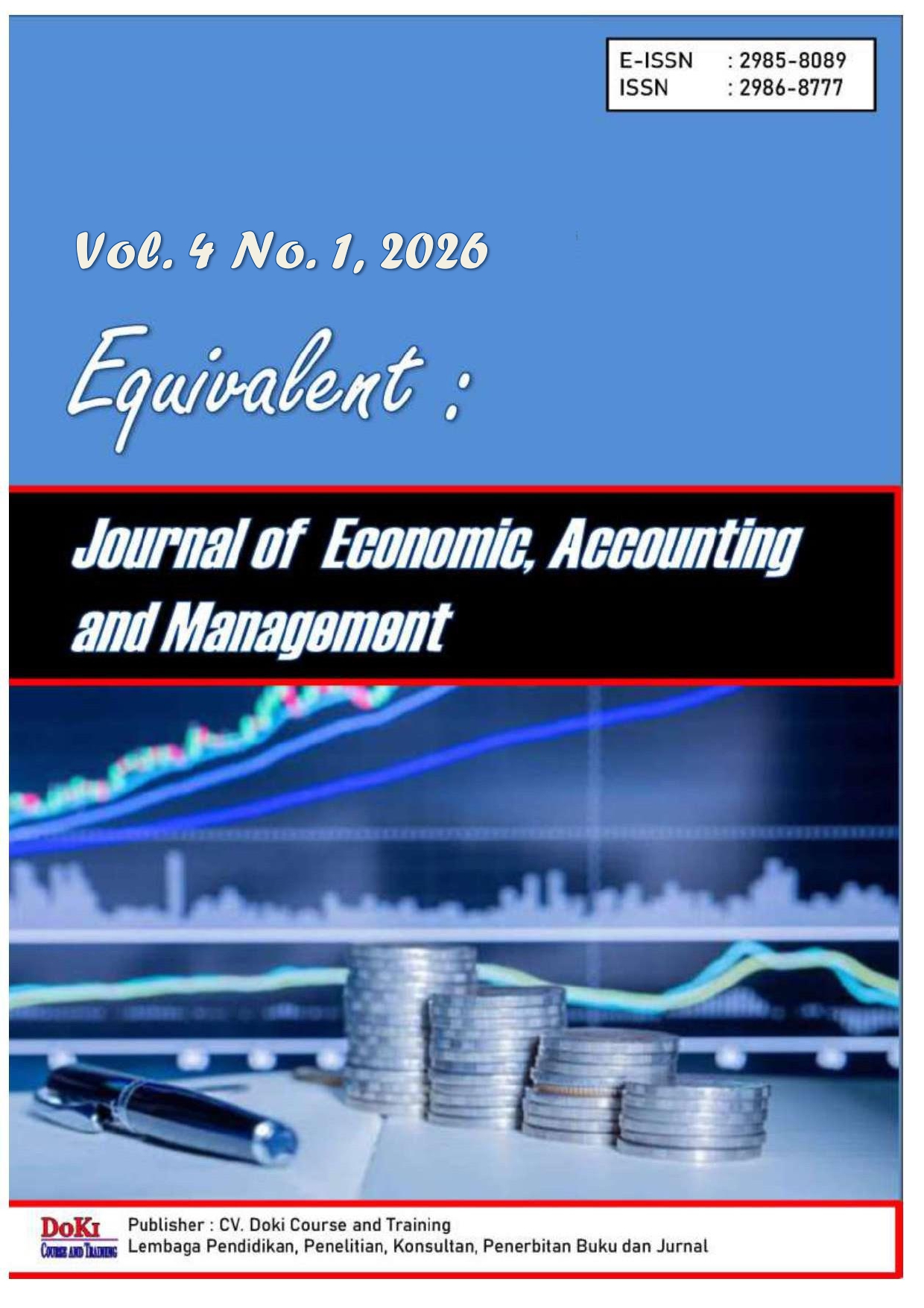
The Influence Of Work Culture, Morality and Leadership on Performance Mediated by Organizational Commitment In Employees PLN UP2D Aceh
DOI:
https://doi.org/10.61994/equivalent.v4i1.1789Keywords:
Ethical Work Culture, Leadership, Organizational Commitment, Employee PerformanceAbstract
The purpose of this study was to investigate the impact of Ethical Work Culture and Leadership on Employee Performance, with Organizational Commitment as a mediating factor for employees at PLN UP2D Aceh. A quantitative methodology was adopted, and data were collected through a survey administered to 41 participants. The analysis used Partial Least Squares–Structural Equation Modeling (PLS-SEM) to examine the direct and indirect correlations between the study variables. The findings indicate that Ethical Work Culture positively contributes to Employee Performance and Organizational Commitment, while Leadership significantly influences Organizational Commitment but has no direct impact on Employee Performance. Furthermore, it was shown that Organizational Commitment acts as a mediator in the influence of Ethical Work Culture and Leadership on Employee Performance. These results emphasize that fostering a work environment based on ethical principles and strong leadership is crucial for improving employee performance by strengthening organizational commitment.
References
[1] Armstrong, M. (2022). Armstrong’s handbook of human resource management practice (15th ed.). London: Kogan Page.
[2] Dessler, G. (2022). Human resource management (16th ed.). New York: Pearson Education.
[3] Dessler, G. (2023). Human resource management (17th ed.). New York: Pearson Education.
[4] Lussier, R. N., & Achua, C. F. (2022). Leadership: Theory, application, and skill development (7th ed.). Boston: Cengage Learning.
[5] Luthans, F. (2021). Organizational behavior: An evidence-based approach (14th ed.). New York: McGraw-Hill Education.
[6] Mulyadi. (2022). Manajemen Source daya manusia berbasis nilai dan etika kerja. Jakarta: Rajawali Pers.
[7] Northouse, P. G. (2021). Leadership: Theory and practice (9th ed.). Thousand Oaks, CA: Sage Publications.
[8] Rakhmawati, D. (2021). AKHLAK Work Culture dalam meningkatkan Employee Performance. Jurnal Manajemen dan Etika Kerja, 6(2), 115–128.
[9] Robbins, S. P., & Judge, T. A. (2021). Organizational behavior (18th ed.). New York: Pearson Education.
[10] Rakhmawati, S. (2021). AKHLAK Work Culture dalam meningkatkan Employee Performance BUMN. Yogyakarta: Deepublish.
[11] Robbins, S. P., & Judge, T. A. (2017). Organizational behavior (17th ed.). Pearson.
[12] Sekaran, U., & Bougie, R. (2016). Research methods for business: A skill-building approach (7th ed.). Wiley.
[13] Sugiyono. (2017). Metode penelitian kuantitatif, kualitatif, dan R&D (26th ed.). Alfabeta.
[14] W Pranoto, B Mesra(2024), The Influence of Work Motivation and Leadership Style On Employee Performance Through Job Satisfaction as A Mediating Variable at The Employment BPJS Sumbagut Regional Office
[15] Y Anwar, KF Ferine, NS Sihombing, (2020) Competency of human resources and customer trust on customer satisfaction and its consequence on customer retention in the hospitality industry north sumatra, Journal of Environmental Management & Tourism
Downloads
Published
Issue
Section
License
Copyright (c) 2026 Agung Saputra, Mesra B, Elfitra Desi (Author)

This work is licensed under a Creative Commons Attribution-NonCommercial 4.0 International License.