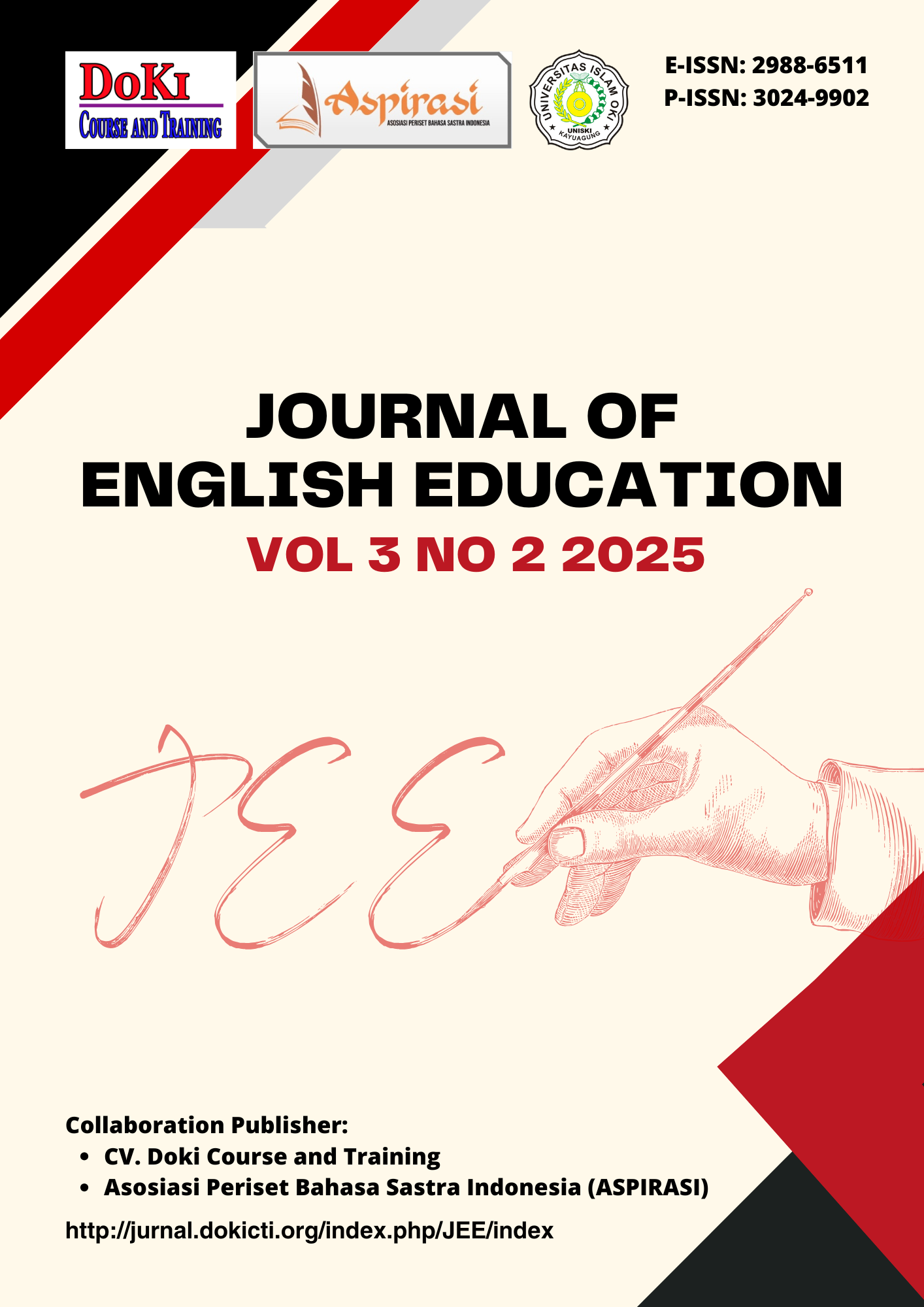
Viral Voices in Language Learning: The Role of TikTok English Songs in Enhancing EFL Learners’ Vocabulary Retention
DOI:
https://doi.org/10.61994/jee.v3i2.1096Keywords:
TikTok songs , Vocabulary retention , EFL learners , Authentic materials, Digital mediaAbstract
TikTok has evolved as one of the most influential internet platforms in recent years. TikTok, recognized for its brief videos and viral phenomena, provides a diverse array of audio-visual content, including music-centric material that frequently incorporates popular English songs. This study investigates the use of popular English TikTok songs as authentic digital materials to enhance vocabulary retention in an EFL (English as a Foreign Language) context. With the growing integration of digital media in students’ daily lives, platforms like TikTok offer engaging and context-rich opportunities for language learning. Adopting qualitive method through case study design, this research explored the experiences, perceptions, and learning behaviors of students at SMAN 1 Pamekasan who actively used TikTok and engaged with English songs on the platform. Data were collected through semi-structured interview with 3 participants, Thematic analysis revealed three main findings: (1) the songs significantly increased learners’ motivation and engagement; (2) vocabulary retention improved due to repeated and contextualized exposure to language; and (3) emotional and social interactions supported deeper learning. The results suggest that integrating familiar and enjoyable content such as TikTok songs into classroom instruction can bridge the gap between formal education and students’ digital experiences, leading to more meaningful and effective vocabulary acquisition. These findings highlight the pedagogical value of leveraging students' media habits to support learner-centered and engaging language instruction.
References
Alisaari, J., & Heikkola, L. M. (2017). Music playschool enhances children’s linguistic skills. Music Education Research, 19(1), 1–14.
Cakir, I. (2015). Instructional materials commonly employed in English language teaching. Procedia - Social and Behavioral Sciences, 191, 274–281.
Gilmore, A. (2007). Authentic materials and authenticity in foreign language learning. Language Teaching, 40(2), 97–118.
Harmer, J. (2007). The Practice of English Language Teaching (4th ed.). Pearson Education Limited.
Ismail, N., & Aziz, N. H. (2024). Incidental vocabulary learning through short-video platforms: A systematic review. Journal of Language and Digital Pedagogy, 5(1), 22–39. https://doi.org/10.23917/jldp.v5i1.24120
Li, M., & Dervin, F. (2021). Social interaction and meaning-making in digital language learning spaces. Language, Culture & Digital Education, 14(2), 101–118. https://doi.org/10.1080/21931674.2021.1889421
Murphey, T. (1992). Music and Song. Oxford University Press.
Nation, I. S. P. (2001). Learning Vocabulary in Another Language. Cambridge University Press.
Oxford, R. (2020). Emotion in language learning: A new theoretical framework for affective engagement. Studies in Second Language Learning and Teaching, 10(1), 5–28. https://doi.org/10.14746/ssllt.2020.10.1.1
Peachey, N., & Withers, L. (2019). Digital Tools for Teachers: Trainers' Manual. British Council.
Reinders, H., & Benson, P. (2021). Digital autonomy and learner-driven language learning practices. Language Learning & Technology, 25(2), 1–20. https://doi.org/10125/44725
Richards, J. C. (2015). Key Issues in Language Teaching. Cambridge University Press.
Schmitt, N. (2020). Understanding vocabulary acquisition: Revisiting key principles. The Language Learning Journal, 48(4), 389–403. https://doi.org/10.1080/09571736.2020.1720974
Sun, P., & Yang, F. (2022). Short-form video platforms as motivational learning environments: Evidence from EFL learners. Computer Assisted Language Learning, 35(8), 1590–1608. https://doi.org/10.1080/09588221.2021.1959581
Thornbury, S. (2022). Lived linguistic input: Rethinking vocabulary pedagogy in the digital era. ELT Journal, 76(3), 345–353. https://doi.org/10.1093/elt/ccac007
Webb, S. (2008). Receptive and Productive Vocabulary Learning: The Effects of Reading and Writing on Word Knowledge. Studies in Second Language Acquisition, 30(1), 33–52.
Wong, C. Y., & Hashim, H. (2021). Reducing anxiety through music-mediated digital learning in EFL classrooms. Asian Journal of Second Language Acquisition, 3(2), 55–70. https://doi.org/10.1234/ajsla.v3i2.118
Yang, L. (2020). Learners’ attention and engagement in short-video mobile learning environments. Interactive Learning Environments, 28(7), 923–937. https://doi.org/10.1080/10494820.2019.1709210
Zhou, Y. (2022). Peer interaction and micro-learning in TikTok-based EFL activities. Journal of Emerging Digital Pedagogies, 2(1), 44–61. https://doi.org/10.31124/jedp.v2i1.457
Downloads
Published
Issue
Section
License
Copyright (c) 2025 Nabila Rana Hanansi, Nuri Fitriyah, Konitatul Maghfirah, Nasrullah, Musbehah, Henny Uswatun Hasanah

This work is licensed under a Creative Commons Attribution-ShareAlike 4.0 International License.

Journal of English Education by https://jurnal.dokicti.org/index.php/JCSS/index
is licensed under a Creative Commons Attribution-ShareAlike 4.0 International Licensel