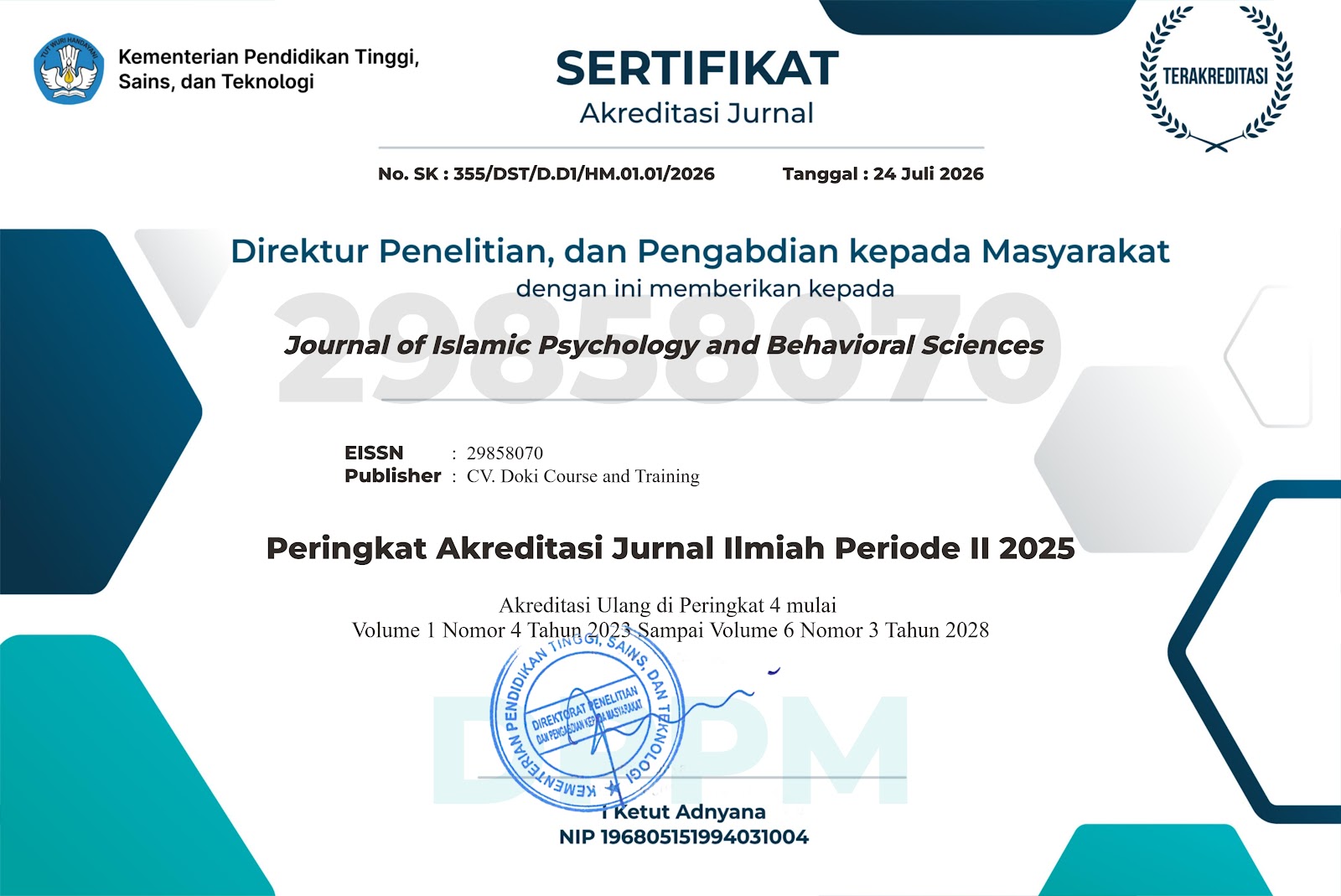
Accreditation Journal
Peer Review Process Policy
Journal of Islamic Psychology and Behavioral Sciences (JIPBS) implements a rigorous double-blind peer-review process to ensure the quality, originality, relevance, methodological rigor, and scientific integrity of all manuscripts submitted to the journal. Under this system, the identities of both authors and reviewers are concealed throughout the peer-review process. Each manuscript that successfully passes the initial editorial assessment is normally evaluated by a minimum of two independent reviewers with appropriate expertise in the subject area of the manuscript.
The peer-review process and reviewer responsibilities of JIPBS are developed with reference to the Committee on Publication Ethics (COPE) Ethical Guidelines for Peer Reviewers. These guidelines emphasize that peer review is an essential component in maintaining the integrity of the scholarly record and that reviewers are expected to conduct their assessments responsibly, ethically, objectively, confidentially, and within an appropriate timeframe.
Initial Editorial Assessment
All submitted manuscripts first undergo an initial editorial assessment conducted by the editorial team. This assessment includes evaluation of:
- suitability of the manuscript to the journal’s focus and scope;
- compliance with the journal’s author guidelines;
- manuscript structure and overall academic quality;
- methodological adequacy;
- originality and contribution of the study;
- compliance with research and publication ethics; and
- similarity or potential plagiarism based on similarity-checking software.
Manuscripts that fall outside the journal’s scope, fail to meet minimum academic or methodological standards, substantially violate the journal’s author guidelines, or raise serious ethical or originality concerns may be rejected by the editor without proceeding to external peer review.
The average time for the initial editorial assessment is approximately 14 days.
Reviewer Selection and Assignment
Manuscripts that successfully pass the initial editorial assessment are forwarded to at least two independent reviewers under the double-blind peer-review system. Reviewers are selected based on their expertise, academic competence, research experience, and relevance to the subject matter of the manuscript.
In accordance with COPE guidance, reviewers should accept a review assignment only when they possess sufficient expertise to evaluate the manuscript and are able to provide a fair and unbiased assessment. Reviewers should inform the editor when any aspect of the manuscript falls substantially outside their area of expertise.
Reviewers must also disclose any actual, potential, or perceived competing or conflicting interests that could affect the impartiality of their assessment. Such interests may include personal, professional, intellectual, institutional, financial, political, religious, or other relationships relevant to the manuscript or its authors. When a conflict of interest may compromise an objective review, the reviewer should decline the invitation or immediately consult the editor.
Reviewer Responsibilities and Ethical Conduct
JIPBS expects all reviewers to follow internationally recognized principles of ethical peer review. In accordance with the COPE Ethical Guidelines for Peer Reviewers, reviewers are expected to:
- Maintain confidentiality. Manuscripts received for review must be treated as confidential documents. Reviewers must not share, discuss, reproduce, distribute, or disclose information from a manuscript to unauthorized persons. Reviewers must not involve another person in the review process without prior permission from the journal.
- Protect unpublished information. Data, arguments, interpretations, methods, ideas, or other unpublished material obtained through peer review must not be used for the reviewer’s own research, personal advantage, the advantage of another person or organization, or to disadvantage or discredit others.
- Provide objective and constructive assessments. Reviews should be fair, evidence-based, academically reasoned, and focused on the scholarly quality of the manuscript. Personal criticism, hostile language, defamatory comments, unfounded accusations, or inappropriate remarks concerning authors are not acceptable.
- Avoid bias and discrimination. Manuscripts must be evaluated solely on their academic and scientific merit. Reviewers should not allow their assessment to be influenced by the authors’ nationality, gender, institutional affiliation, religious or political beliefs, personal characteristics, manuscript origin, or commercial considerations.
- Declare competing interests. Reviewers must promptly disclose any competing interest that could interfere with an impartial evaluation. If a reviewer becomes aware of a potential conflict after accepting the assignment, the reviewer should immediately notify the editor.
- Review within the agreed timeframe. Reviewers should accept assignments only when they are able to complete the review within the journal’s requested timeframe. If additional time is required or the reviewer becomes unable to complete the review, the editorial office should be informed promptly.
- Report suspected ethical violations. If reviewers identify possible plagiarism, duplicate or redundant publication, data fabrication or falsification, unethical research practices, substantial similarity with another publication, or other potential research or publication misconduct, they should confidentially notify the editor. Reviewers should not independently investigate allegations or directly contact the authors regarding such concerns.
- Avoid inappropriate citation requests. Reviewers should not request authors to cite the reviewer’s own publications or those of associates merely to increase citation counts or visibility. Any recommendation for additional references must have a legitimate scholarly justification and be directly relevant to strengthening the manuscript.
- Respect the scope of the manuscript. Reviewers may recommend additional analyses or clarification when necessary to support the manuscript’s claims; however, they should not unnecessarily require authors to extend the study beyond its reasonable scope.
- Maintain accountability for the review. Reviewers are responsible for the content and quality of the review they submit. Recommendations regarding acceptance, revision, or rejection should be consistent with the substantive comments provided to the authors and editor.
The obligation to maintain confidentiality continues after the peer-review process has been completed. Reviewers must not disclose information concerning the manuscript or their review unless disclosure has been authorized by the journal and, where appropriate, the authors.
Peer-Review Evaluation
During peer review, reviewers are generally expected to evaluate the manuscript in relation to:
- originality, novelty, and significance of the research;
- relevance to Islamic psychology and behavioral sciences;
- clarity of research objectives or questions;
- adequacy of theoretical and conceptual foundations;
- appropriateness and rigor of the research methodology;
- validity and reliability of data and findings;
- quality and transparency of data analysis;
- consistency between results, discussion, and conclusions;
- contribution of the study to existing scholarship;
- adequacy, relevance, and currency of references;
- compliance with research and publication ethics; and
- overall clarity, coherence, and scholarly presentation of the manuscript.
Reviewers should provide comments that are sufficiently specific and constructive to assist authors in improving their manuscripts and to support editors in making informed editorial decisions.
The average time allocated for the peer-review process is approximately 14 days. Reviewers who require additional time are expected to communicate with the editorial office as early as possible.
Editorial Decision and Revision
Based on the reviewers’ reports and recommendations, the editor may issue one of the following decisions:
- Accept Submission
- Revisions Required / Minor Revision
- Resubmit for Review / Major Revision
- Decline Submission
When revisions are required, authors are expected to carefully address the reviewers’ and editors’ comments and submit a revised manuscript together with an appropriate response to the comments. Depending on the extent and nature of the revisions, the revised manuscript may be returned to the original reviewers or evaluated by the editorial team.
Multiple rounds of review may be conducted when necessary to ensure that substantive academic, methodological, or ethical concerns have been adequately addressed. Consequently, the total duration of the peer-review process may vary depending on the complexity and quality of the manuscript, reviewer availability, the extent of revisions required, author responsiveness, and the number of review rounds.
Reviewer recommendations are advisory and constitute an important component of the editorial decision-making process. The final decision regarding acceptance or rejection of a manuscript rests with the Editor in Chief, taking into consideration the reviewers’ reports, the manuscript’s academic quality, compliance with journal policies, and relevant ethical considerations.
Manuscript Processing Time
JIPBS is committed to maintaining a peer-review and publication process that is both rigorous and efficient. Based on the journal’s editorial and production workflow, the estimated manuscript processing timeline is:
- Initial editorial assessment: approximately 14 days
- Peer-review process: approximately 14 days
- Submission to acceptance: approximately 98 days
- Acceptance to online publication: approximately 12 days
- Estimated total time from submission to online publication: approximately 110 days
The 98-day submission-to-acceptance period represents the overall manuscript processing period prior to formal acceptance. It may include initial editorial screening, reviewer selection and invitation, external peer review, author revisions, additional review rounds when required, editorial evaluation of revised manuscripts, and the final editorial decision.
Accordingly, the estimated 14-day initial editorial assessment and 14-day peer-review period are components of the overall submission-to-acceptance workflow and should not necessarily be interpreted as additional periods beyond the stated 98 days.
Once a manuscript has been formally accepted, it proceeds to the production stage. This stage may include copyediting, language and technical editing where necessary, layout editing, author proofreading, metadata verification, final quality control, and preparation for online publication. The average time from formal acceptance to online publication is approximately 12 days.
Overall, the estimated manuscript processing time from initial submission to online publication is approximately 110 days, consisting of an average of 98 days from submission to acceptance and approximately 12 days from acceptance to online publication.
These processing times represent average estimates rather than guaranteed deadlines. Actual processing times may vary according to manuscript quality and complexity, reviewer availability, the extent of revisions required, author and reviewer responsiveness, the number of review rounds, ethical or methodological issues requiring additional evaluation, and other editorial considerations.
JIPBS remains committed to maintaining a rigorous, fair, confidential, transparent, ethical, and timely peer-review process while safeguarding the integrity and quality of the scholarly record.
Ethical Guidelines and Reference
The Peer Review Process and Policy of the Journal of Islamic Psychology and Behavioral Sciences (JIPBS) is developed with reference to the ethical principles and recommendations provided by the Committee on Publication Ethics (COPE), particularly the COPE Ethical Guidelines for Peer Reviewers.
Reviewers, editors, and other parties involved in the peer-review process are expected to uphold the principles of confidentiality, impartiality, professional responsibility, transparency regarding competing interests, constructive scholarly assessment, timeliness, and research and publication integrity as outlined in the COPE guidance.
Reference:
COPE Council. COPE Ethical Guidelines for Peer Reviewers. Version 2, September 2017. Committee on Publication Ethics (COPE). DOI: 10.24318/cope.2019.1.9.