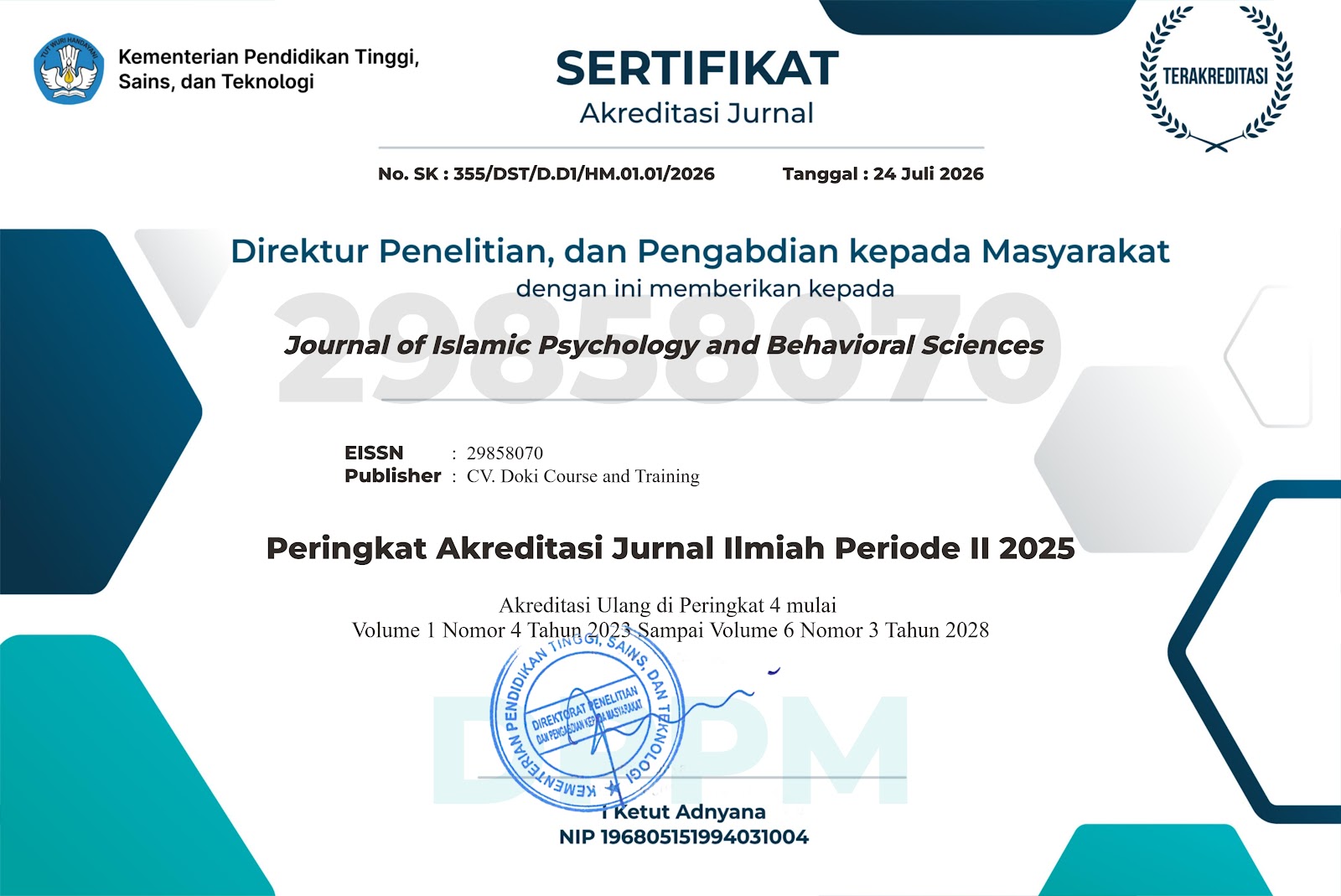
Accreditation Journal
Authorship and Contributorship Policy
1. Purpose and Principles
The Journal of Islamic Psychology and Behavioral Sciences (JIPBS) recognizes authorship as both scholarly credit and responsibility. Authorship should accurately identify individuals who have made substantial intellectual contributions to the research and who are willing to take responsibility for the accuracy, integrity, and ethical conduct of the published work.
This policy aims to:
- ensure that individuals who make substantial scholarly contributions receive appropriate authorship credit;
- prevent honorary, gift, guest, coercive, purchased, fictitious, and ghost authorship;
- distinguish authors from contributors who do not meet authorship criteria;
- promote transparency regarding individual author contributions;
- establish the responsibilities of corresponding authors and co-authors; and
- provide procedures for changes to authorship and the resolution of authorship-related concerns.
Authors are primarily responsible for determining who qualifies for authorship and for agreeing on the order of authors before submission. JIPBS may request supporting documentation or institutional clarification when potential authorship irregularities are identified.
2. Criteria for Authorship
Every person listed as an author must meet all four of the following criteria:
1. Substantial Contribution
The author has made a substantial contribution to the conception or design of the study; or to the acquisition, analysis, or interpretation of data.
2. Intellectual Contribution to the Manuscript
The author has participated in drafting the manuscript or critically revising it for important intellectual content.
3. Approval of the Final Version
The author has reviewed and approved the final version of the manuscript to be published.
4. Accountability
The author agrees to be accountable for the accuracy and integrity of the work and to cooperate in addressing any questions concerning the research or publication.
All individuals who satisfy these criteria should be appropriately identified as authors.
A person's academic position, institutional authority, seniority, reputation, supervision, provision of facilities, or funding alone does not qualify that individual for authorship.
3. Author Responsibilities
Each author is responsible for the accuracy and integrity of their individual contribution.
All authors should:
- understand the overall objectives, methods, findings, and conclusions of the research;
- be aware of the principal contributions made by their co-authors;
- have reasonable confidence in the integrity of their co-authors' contributions;
- cooperate with requests for data, ethical documentation, clarification, corrections, or investigations; and
- participate in resolving legitimate questions concerning the integrity or accuracy of the published work.
Authorship entails collective scholarly responsibility. An author cannot completely avoid responsibility for the integrity of a publication merely by stating that another author was responsible for a particular section.
4. Author Contribution Statement
JIPBS requires manuscripts to include an Author Contribution Statement describing the contribution of each author.
Authors are encouraged to use the Contributor Roles Taxonomy (CRediT), where applicable. Contributions may include:
- Conceptualization;
- Data Curation;
- Formal Analysis;
- Funding Acquisition;
- Investigation;
- Methodology;
- Project Administration;
- Resources;
- Software;
- Supervision;
- Validation;
- Visualization;
- Writing – Original Draft; and
- Writing – Review & Editing.
An author may perform multiple roles, and the same role may be attributed to more than one author.
All authors must review and approve the contribution statement before submission.
The assignment of one or more CRediT roles does not automatically qualify an individual for authorship. Every author must still satisfy the authorship criteria established in this policy.
5. Non-Author Contributors and Acknowledgements
Individuals who contributed to the research or manuscript but do not satisfy all authorship criteria should not be listed as authors. Their contributions may instead be recognized in the Acknowledgements section.
Such contributions may include:
- routine data collection;
- administrative or logistical assistance;
- technical assistance;
- language editing or proofreading;
- translation;
- manuscript formatting;
- preparation of illustrations;
- provision of research facilities or equipment;
- general supervision;
- funding acquisition without substantial intellectual involvement; or
- other assistance that does not constitute a substantial intellectual contribution.
The nature of the contribution should be clearly stated. Permission should be obtained before identifying an individual by name in the Acknowledgements.
6. Unacceptable Authorship Practices
JIPBS does not tolerate manipulation of authorship. The following practices are prohibited:
Honorary or Gift Authorship
Listing an individual as an author primarily because of seniority, academic position, reputation, institutional authority, personal relationships, or expectations of reciprocal authorship when the person does not satisfy the authorship criteria.
Guest Authorship
Including a prominent, senior, or influential individual primarily to enhance the perceived credibility or likelihood of acceptance of a manuscript.
Coercive Authorship
Using academic, supervisory, employment, financial, or institutional authority to demand authorship without making a qualifying scholarly contribution.
Ghost Authorship
Excluding an individual who made a substantial contribution qualifying for authorship or concealing the substantial involvement of another individual or organization in preparing the manuscript.
Purchased or Sold Authorship
Buying, selling, offering, exchanging, transferring, or otherwise commercially trading positions in an article's author list.
Fictitious or Fraudulent Authorship
Listing a nonexistent individual, using a false identity, impersonating another researcher, or including another person's identity without authorization.
Authorship Without Consent
Including an individual's name as an author without that individual's knowledge, approval of the manuscript, and agreement to accept authorship responsibility.
Suspected authorship manipulation may result in suspension of manuscript processing, rejection, correction, retraction, notification of relevant institutions, or other appropriate action under JIPBS publication ethics policies.
7. Author Order
Authors are collectively responsible for determining the order in which their names appear.
JIPBS does not determine author order and does not automatically interpret any particular author position as representing a specific level of contribution.
All authors should discuss and agree upon the author order before initial submission.
Where two or more authors have contributed equally, an equal-contribution statement may be included provided that it accurately represents their respective contributions and has been approved by all authors.
8. Corresponding Author
The Corresponding Author serves as the principal contact between the author group and JIPBS throughout submission, peer review, production, publication, and post-publication communication.
The Corresponding Author is responsible for:
- ensuring that all listed authors satisfy the journal's authorship criteria;
- ensuring that eligible authors have not been omitted;
- obtaining agreement regarding the author list and author order;
- ensuring the accuracy of author names, affiliations, ORCID identifiers, and contact information;
- ensuring that all authors have approved the manuscript before submission;
- coordinating the Author Contribution and Conflict of Interest statements;
- keeping all co-authors informed about editorial correspondence and decisions;
- coordinating revisions and obtaining approval of the final manuscript;
- responding promptly to editorial requests;
- ensuring that ethical approval, informed consent, research data, permissions, and supporting documentation can be provided when required; and
- remaining available after publication to address legitimate questions, corrections, or research-integrity concerns.
The responsibilities of the Corresponding Author do not diminish the individual and collective responsibilities of the other authors.
9. Use of Artificial Intelligence and Authorship
Generative Artificial Intelligence (AI) systems and AI-assisted tools cannot be listed as authors or co-authors of articles published in JIPBS.
AI systems cannot satisfy the journal's authorship criteria because they cannot:
- take responsibility for the accuracy and integrity of research;
- approve the final manuscript;
- declare conflicts of interest;
- hold authorship rights; or
- independently respond to questions concerning research integrity.
Human authors remain fully responsible for all content generated, edited, translated, analyzed, or otherwise assisted by AI.
Where AI has been used substantively in preparing a manuscript, its use must be transparently disclosed in accordance with the journal's policy on the use of Artificial Intelligence.
AI assistance does not reduce the contribution or accountability required of human authors.
10. Finalization of the Author List
The complete author list should be finalized before initial submission and must be consistent between the manuscript and the journal's submission metadata.
Before submission, all authors should agree on:
- inclusion in the author list;
- author order;
- designation of the Corresponding Author;
- institutional affiliations;
- Author Contribution Statement;
- Conflict of Interest declaration; and
- the version of the manuscript being submitted.
JIPBS reserves the right to request ORCID identifiers, institutional email confirmation, contribution records, authorship declarations, or other reasonable documentation to verify authorship and researcher identity.
11. Changes to Authorship Before Acceptance
Requests to add, remove, replace, or reorder authors after initial submission will only be considered when a legitimate and clearly documented reason is provided.
The Corresponding Author must provide:
- a description of the requested change;
- a clear justification for the change;
- an updated Author Contribution Statement; and
- written agreement from all existing authors and any author being added or removed.
An individual being added must confirm that they meet the journal's authorship criteria, approve the manuscript, and accept responsibility for the work.
An individual being removed must confirm their agreement to the removal.
JIPBS may temporarily suspend peer review or editorial processing while an authorship-change request is evaluated. The final decision regarding such changes rests with the Editor.
12. Changes to Authorship After Acceptance
After a manuscript has been formally accepted, changes involving the addition, removal, replacement, or rearrangement of authors will be considered only under exceptional circumstances.
Publication may be suspended while the request is evaluated.
JIPBS may reject an authorship-change request when:
- the justification is inadequate;
- the requested change is inconsistent with documented contributions;
- consent from affected authors is unavailable;
- there is evidence of coercion, purchase, sale, or manipulation of authorship; or
- an unresolved authorship dispute requires institutional investigation.
Authors should therefore ensure that the author list is complete and accurate before submission.
13. Changes to Authorship After Publication
Authorship information in a published JIPBS article will not be changed silently.
When a legitimate authorship change is approved after publication, JIPBS will normally issue a formal Correction linked to the original article.
The journal may require:
- written agreement from all authors;
- an updated Author Contribution Statement;
- supporting institutional documentation;
- confirmation from individuals being added or removed; and
- an explanation of why the correct authorship information was not provided before publication.
Where an authorship dispute remains unresolved and potentially affects the integrity of the publication, JIPBS may take appropriate editorial action in accordance with its correction, expression of concern, or retraction policies.
14. Authorship Disputes
JIPBS does not normally adjudicate disputes concerning which individuals deserve authorship or the appropriate order of authors when the parties involved cannot reach agreement.
In cases of unresolved authorship disputes, the journal may:
- request that the authors resolve the issue collectively;
- suspend peer review, acceptance, production, or publication;
- request documentation concerning individual contributions;
- refer the matter to the relevant institution(s);
- request a determination from an employer, university, research institution, ethics committee, or funding organization; or
- take appropriate action when there is evidence of research or publication misconduct.
JIPBS will generally rely on documented agreement among the affected authors or an appropriate institutional determination before making substantive changes to an author list.
15. Submissions from Editors and Editorial Board Members
Editors and Editorial Board members who submit manuscripts to JIPBS must satisfy the same authorship, ethical, and scientific requirements as all other authors.
When an Editor or Editorial Board member is an author or co-author of a submitted manuscript, they must have no involvement in the editorial handling of that manuscript.
The manuscript will be assigned to another qualified editor who has no relevant conflict of interest. The author-editor will not participate in reviewer selection, peer-review communication, editorial discussion, or the final publication decision.
16. Policy Review
The Journal of Islamic Psychology and Behavioral Sciences (JIPBS) may periodically review and update this Authorship and Contributorship Policy to maintain consistency with developments in scholarly publishing, publication ethics, authorship standards, contributor taxonomies, and internationally recognized research-integrity practices.
The principles of this policy are adapted to the editorial context and disciplinary scope of JIPBS and are intended to promote fair authorship attribution, transparency of scholarly contributions, accountability, and research integrity.